Showing posts with label Sustainable Solutions. Show all posts

Saturday, July 27, 2019

Thursday, July 25 -Sheep, Greening Waipara, and Lip Sync

The start of our three day and two night trip was in full sun and pretty warm. Our first stop in the gatorwakawa was a green development called Pegasus. Here, we explored some for the pluses (rain gardens and swales, dark-sky lighting, and use of native plants) and minuses (used a lot of exotic plants) that the developer helped to set up. At the back of the development, there was some conserved open space where they are just beginning to restore with native plantings.

At the beach near Pegasus development
After tea time at Pukeko Junction, we explored the Greening Waipara project across many wineries and within the community of Waipara. The wineries incorporated biodiversity trails and planted natives within the planted vines. The idea is to provide habitat for insect predators that would eat the pests of the vines. Also - the biodiversity trails allow people to experience a little bit of their natural heritage while sipping their wine. We met with Daryl Harris, the local champion of the project and 4th generation rancher in the area. Daryl is a strong supporter of the project and has planted thousands of native plants in the area. He also uses his sheep to graze within the vineyards to keep weeds down.

Colin at Pegasus Bay Winery and the biodiversity trail
A longfin eel was sighted in the pond
Daryl explaining hos philosophy of pesticide reduction and planting natives

Daryl's Bear (the sheepdog) herding merino sheep


Daryl sorting out the sheep
We placed our belongings at the Sleeper Cars Backpackers at Waipara. We then went over to Daryl's for a home cooked meal of lamb, beef, roasted veggies and pavlova for dessert. Incredible! Then we had our traditional lip sync contest - much fun all around. Even had several games of the card game mafia. After dinner, had a cooold night in the sleeper cars


Night night. Dr H

Wednesday, July 24, 2019

Over the Hedge and Through the Bush, "Hey Give Me a Push!"

Throughout New Zealand in the winter, it is acutely noticeable which plants are native and which are exotic. Non-native plants, those not adapted to the climate, tend to shed their leaves during the colder and darker winter months. In turn, their barren grey branches await sunnier October days to take full advantage of their photosynthetic potential. Endemic plants, however, are better acclimated to Aotearoa. In the states, we would colloquially call these plants "ever-green". Most land owners plant hedgerows lined with exotics to surround their property and protect it from wind (especially if farming), but some land owners break the mold and choose to plant natives instead.

These "ever-green" native plants are exactly the kinds of plants Pauline and Malcolm choose to circle their 15 acre property. A decade or so ago, Dr. Hostetler worked up the gumption to visit this retired couple after driving by their property many times. Ever since, every UF in NZ class has visited them and been a hit! Today we saw the usual suspects when it comes to native flora: Harekeke, kahikatea, totara, kowhai, five finger, juvenile lancewoods, manuka, cabbage palm, tarata, and a whole slew of pittosporums. Spread out amongst these natives, a few exotics stood: Gum trees, oaks, pines, rhodendrons, and azaleas. Pauline and Malcolm are admirers of birds, and their property was very conducive to bird spotting. Their property is one of the few unique ones in the Selwyn area to feature natives over exotics.

Malcolm greets the group and introduces his property.
Malcolm and Pauline's beautiful home.

Spot of tea in hand, Pauline regaled us with tales of the couple moving to the area, the evolution of their piece of land, the first exotics they planted, the earthquakes, and the rabbit problem. Malcolm is more keen to removing rabbits with a .22LR rifle, but the couple agreed to lay out poison from now on. Malcolm manages 20 head of cattle on his property, but used to raise sheep in the paddocks. A pair of "chooks" - chickens - , also roam their section of the yard, but prefer the warm and dry coop far away from the prying eye of harriers and falcons. Other birds that call the residence home are California Quail and pheasants. 
Native hedgerow in the background with exotics in the foreground.
Chook house in the foreground with more native hedgerows in the back.
"I saw a bunny outside the window looking right at me!"

After heartfelt goodbyes and a quick group photo, the class filed into the Gator Waka to head towards Christchurch and the Art Gallery. Te Puna o Waiwhetu hosted many collections of art from both European and Maori sources. The most compelling piece was "chicken/man", which has been described by the artist, Ron Mueck, as "just the right blend of the mundane and the surreal." A seated man in only his undergarments stares balefully at a chicken standing atop a kitchen table. The chook returns the gaze and now both are locked in a humorous staring contest. The humor is undercut by an air of uncertainty.
If you stare into the abyss, the abyss stares back at you.

Humorous? Absurd? Surreal? Serious? What do you think?
As 19th century philosopher Georg Hegel once formulated, "Art is the sensuous presentation of ideas." What ideas does such a piece present for us to perceive? Is it commentary on humanity's exploitation of animals and their by-products? A more general criticism of man's alienation from nature and how at odds we are with the surrounding environment? The absurdity of life that undercuts existence as a whole? Is it merely art for art's sake? What do you see? Leave a comment below.

After an hour of exploring the museum it was time for lunch and then a quick walk up to the Arts Centre. The Arts Centre was home to many boutique stores selling jewellery, stationary, fudge, and much more. Some bought goods for personal use, others bought gifts and mementos for home. The final stop in Christchurch for the day was the Margaret Mahy Playground. With enough room for all of us and the local children, we burned off our excess energy on the slides, swings, and jungle-gyms. We also experienced a flying-fox! We missed out on the opportunity at New Brighton Beach and were glad to have pushed our classmates off to zip around.
There go Tati and Grace! Never to be seen again (not really).

Exhausted, we made a quick tea-time stop and Coffee Culture and were briefed on our last overnight trip, Waipara and Kaikoura. Hard to think we only have a week left in New Zealand! - Bauer

Thursday, July 18, 2019

Red Zone Restoration

       Today we revisited the Red Zone to help out with restoration with Dr. Colin Meurk and Scott Butcher from the Avon Otakoro Network. This group was formed in 2015 and does ecological work in the Red Zone by trying to establish a forest park and other vegetation that would’ve existed in this area historically.

The site that we went to is leased to them by the government for about 5 years. This short amount of time makes it hard to do restoration, but the goal is to plant enough natives that eventually the land becomes self-sustaining and there needs to be minimal intervention from the group. They hope that with all the new planting, native forest birds like the Kereru, fantail, and Tui will hopefully come flooding back. In fact, there were several fierce fantails fluttering round our site as we were working, possibly being a positive omen for the future of this land. 

As with most of the sites that we have been completing restoration on, Dr. Meurk reminded us that the central idea for these ecological corridors is to create a stepping stones throughout the city that will provide native wildlife habitat while coexisting with people. The Red Zone is heavily mowed, which encourage the growth of weeds and discourages the growth of native seedlings, and Dr. Meurk estimated that mowing costs about 1-2 million dollars a year. In the end, we ended up planting over 105 native species. This includes coprosma, lancewood, and even some baby totora! 

After stopping for some lunch, we headed on to our next destination. On the way, Dr. Meurk stopped by a river filled with Canadian Geese and other waterfowl. He stopped by a tree with lichen growing on it and let us all try out his handy pocket magnifying glass. He told us about how blue-green aglae fixate nitrogen and that we should all put that small magnifier on our shopping list. 

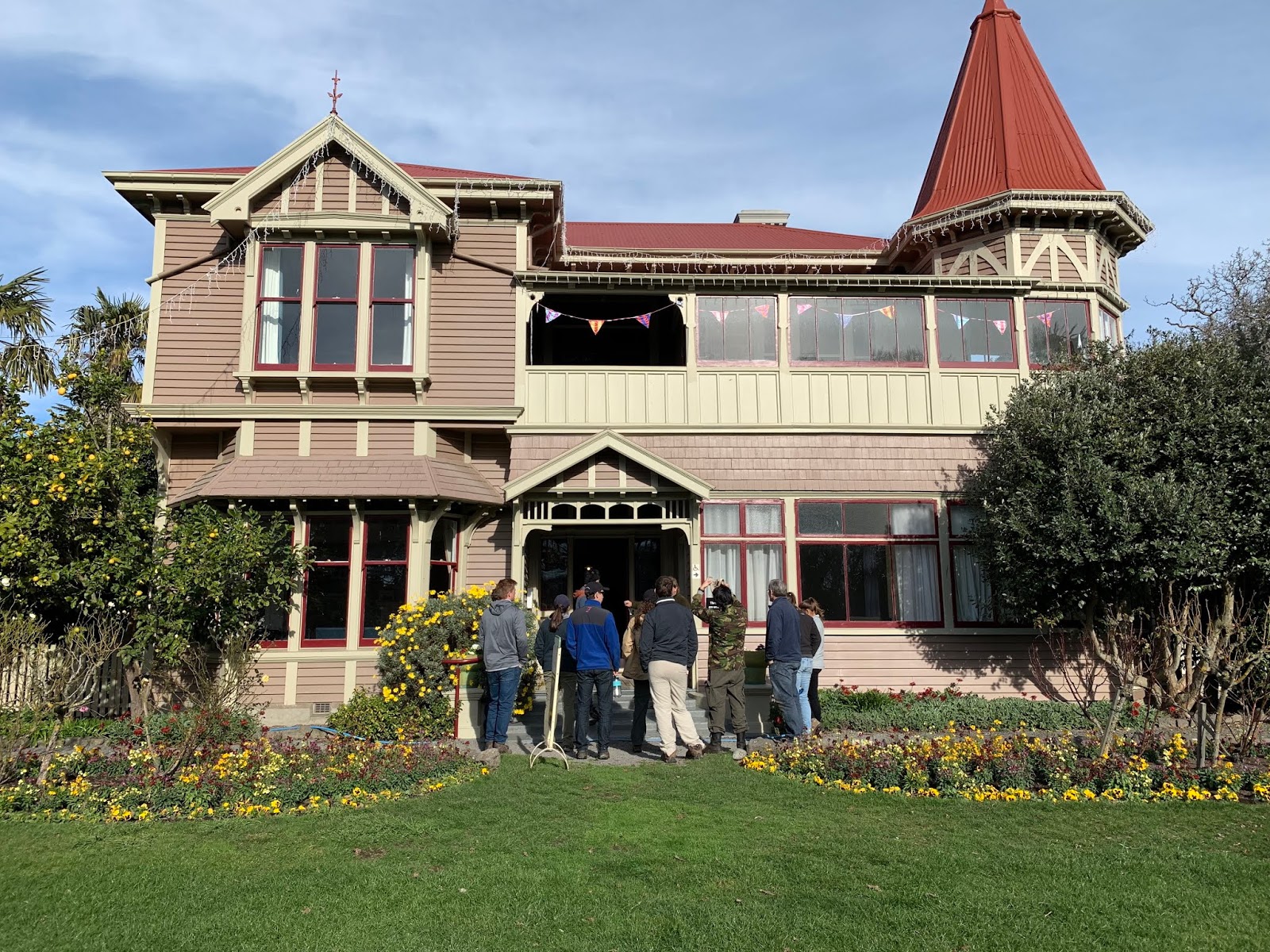
We then went on over to the Avebury House and met with Tanya the keeper of the house. This large Victorian House used to be owned by the Flesher Family back in the 1850s but is now used as a sort of Community Center. Yoga classes, workshops, and various clubs use this space harmoniously. The house has been threatened many times to be torn down, but the community always assembles and saves it. 

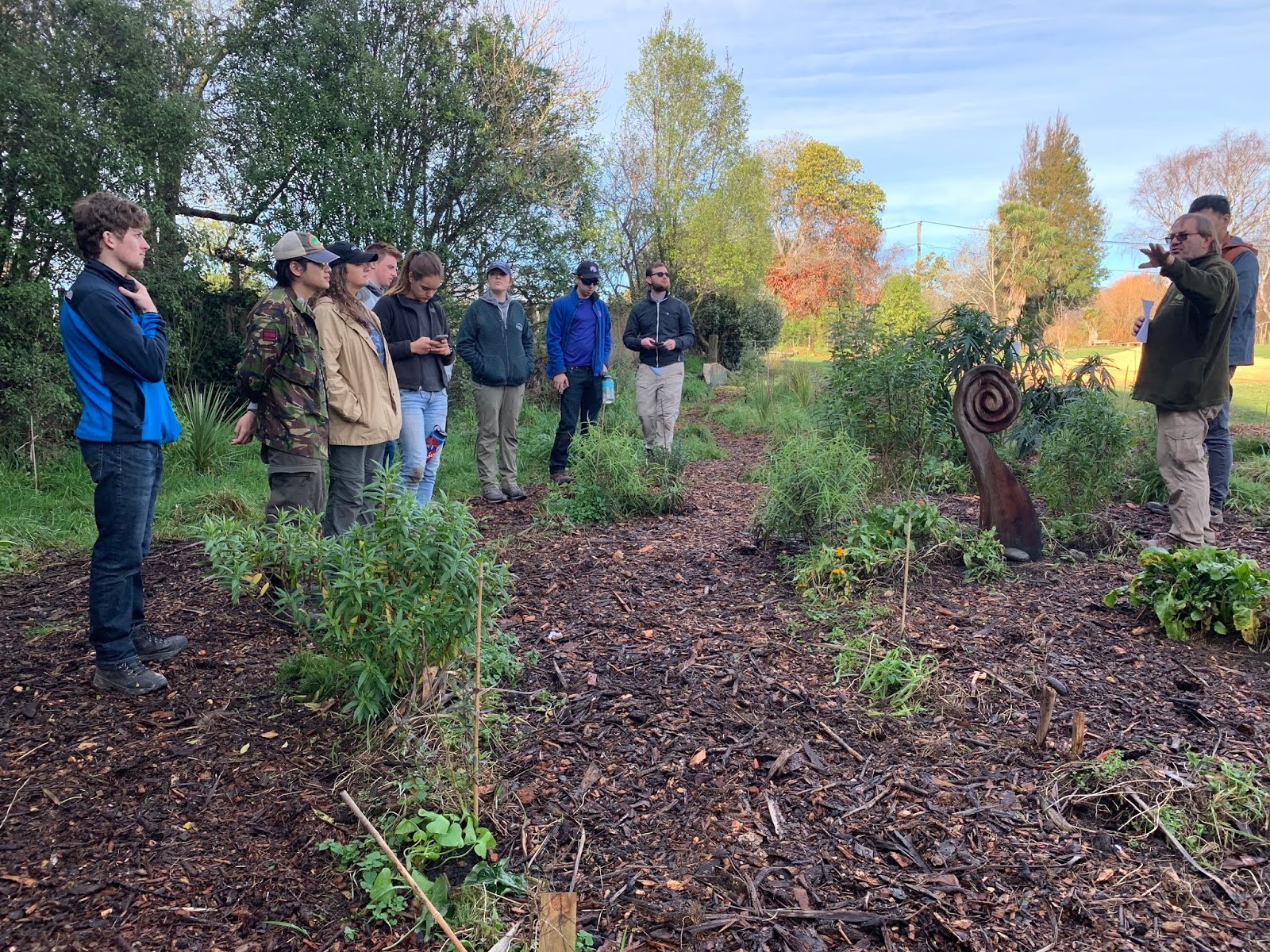
The house also has a community garden that is maintained weekly by citizens of the town and many of the food is either donated or sold. We walked through the native garden, called Koru Garden. It is named after the Maori word for loop or coil, represented by an unfurling silver fern frond. The unfurling fern is a symbol of rebirth, growth, and strength. In fact, a small part of the garden is planted in the shape of a spiral and circulates around a large wooden carving of a fern. Dr. Meurk walked us through the forested part of the garden which is home to large native trees like the totora, lemonwood, and kauri tree. He told us that the canopy cover of the larger trees provides the perfect space for their seedlings to grow. In fact, we stumbled upon two small totora seedlings just beginning their climb towards the sky. 

After saying goodbye to Dr. Meurk and the Avebury House, we piled into the Gator Waka and had teatime at a C4. Tomorrow starts our free weekend in Queenstown, but we will be back on Monday to explore more of the Canterbury region. - Tatiana


Dr. Colin Meurk and the group at the Red Zone

Planting natives and helping to restore the Red Zone

Taking a peak at some lichen growing on this tree

The group at Avebury House

A portion of the community garden at Avebury House that will be donated

The group and Dr. Meurk at the Koru Garden

Learning about the native trees that provide canopy cover to seedlings in the Koru Garden


Tuesday, July 16, 2019

Mountains and Hot Chocolate

Today started off with a lecture given by Dean Anderson discussing the mammal pests in New Zealand. Interestingly enough, there are only two types of native mammals on New Zealand (excluding marine mammals),  the short tailed bat and the long tailed bat. But as Dean Anderson discussed, today you can find multiple types of introduced mammal species such as rats, mice, stoats, possums (not like ours - these are cute and cuddly looking and add to the reasons why folks line up on the side of not wanting to kill them) and hedgehogs. These animals have caused a lot of damage to the native animals found on the island, especially concerning the bird populations - they are the main threat. Dean also discussed the feasibility of Predator Free New Zealand by 2050, with the goal to eradicate possums, rats and stoats by 2050. The eradication of rats has already been made possible on some smaller islands with the help of the toxin 1080. Possums and rats both will consume something with 1080, making it feasible to one day eradicate them. Stoats, however, will not consume bait with 1080, making them harder to eradicate.

Everyone's attention glued to Dean Anderson during his presentation

Once finishing the lecture, we all got into groups to create Logic Models for a specific issue each group wanted to combat. One group wrote about eliminating single use plastics, while another group wrote about eliminating plastic bags in Orlando. It was interesting to see the different inputs and outcomes for each issue.
Tati writing down ideas for her group concerning single use plastics


Bauer proudly holding up his groups poster

After presenting our models we were blessed with a sunny day throughout our hike at Ahriri Scenic Reserve. Once reaching the top up at Coopers Knob we enjoyed the beautiful panoramic views of Quail Island and the surrounding mountains, while even catching a glimpse of Birdlings Flat. At the top, we were also able to learn more about coffee from coffee aficionado himself, Dr. Hostetler. After learning everything about coffee, we were able to use the beautiful native fuchsia trees to help us on on our slippery descent down. We quickly stopped at Governors Bay to look for the White Spoonbill. Unfortunately, since we spent so much time on top of the Port Hills, the tide had already come in over the mud flats and since it was high tide, the likelihood of seeing one was slim.
Lunch with a view

Learning all about coffee from the coffee aficionado himself

We made it to the top!
On the hunt for the White Spoonbill
 We ended the day off by going to a chocolatier at Governor's Bay called She Universe. Even though the hot chocolate machine had been turned off for the day, luck was on our side as we were able to get a taste of their signature hot chocolate and enjoyed coffee and tea and a sampling of truffles. - Tess

Sunday, June 30, 2019

Tied Up In Knots; A Lecture; Mud, Sweat, and Tears; and Building Rocks


After a good night's rest (and Dr. H waking happy knowing that the Crusaders will take on the Jaguars in Super Rugby finals next weekend), we all met up on the Lincoln Uni Tennis Courts for some Low Ropes team building exercises so we could get to know one another better and test out our warm jackets (morning frost and a nice 34 degrees Fahrenheit and sunny).

After brunch, Dr. Hostetler gave his first lecture about conserving and restoring biodiversity. Conservation involves a variety of decision makers, and each stakeholder needs to be engaged from the homeowner, to the developer/landowner and planner. The Canterbury Plains have less than 10 percent of native vegetation remaining. Thus, small native plantings across the plains can have (cumulatively) a huge impact. Once plants get established - birds can forage in these areas and continue to spread the seeds to nearby lands. The class will be working with landowners and NGOs to help restore small parcels of land.

Students taking notes in a makeshift classroom
Then it was off to the Adventure Park to watch the Mud, Sweat, and Tears competition. Sunny day but lots of mud! This is a 10K race through the mud, forest, and hills. Even one of our students (Maryanna) got christened by a mud-slinging participant!

Students watching the race

Unusual costumes!

Here is mud in your eye! (Or in this case on your jacket)
 After our first stop at a fish and chip shop, we went for a walk at the Halswell Quary, where stone used to be mined to build some of the historic buildings in the area.  Halswell stone was used for several historic buildings in Christchurch. Students also began to learn about native flora and fauna in the area (e.g., a fantail was spotted and we saw lots of lemonwood).

Fish and chips with the proprietors.

Catalogue photo shoot at the quarry.

Cheers, Meryl and Dr. Hostetler


Wednesday, June 19, 2019

Greetings from Colin Meurk on a Cold Winter Day in Lincoln

We are so very lucky to get to work with many amazing New Zealanders.  One of our resident gurus is Dr. Colin Meurk who sends you this message today:

Kia ora koutou (hello all)
We look forward to welcoming you all to Aotearoa-New Zealand - and your journey of discovery (if that doesn’t sound too retro). It’s been a frost here this morning (remember to bring the wool jersey - aka sweater), but then just looked out my office window to a clear blue sky here in Lincoln - and wondered if that is your jet up there – a little early! The courtyard is sheltered, so there are 6 m tree ferns (yes, we do metric here), lancewood and our cabbage tree; oh and a fantail just dropped in. You’ll meet them all.  Well, it’s ecology with biogeography, people and design in the mix – and if you hadn’t noticed, the journey has already begun 😊.

Kind wishes
Colin Meurk


Thursday, June 13, 2019

Biomimicry - Challenge Yourself

I love what folks are doing with biomimicry. View the video below to see what a recent high school team winner of the youth challenge came up with as their design for ocean kites for power generation.

I challenge you to take time when we are in New Zealand to observe the natural world around you and feel equally inspired to help meet the demands for our sustainable future.

m : )
Larkspur, CA
Team Category High School
Award Status 1st Place
School/Organization Redwood High School