Saturday, July 27, 2019

Thursday, July 25 -Sheep, Greening Waipara, and Lip Sync

The start of our three day and two night trip was in full sun and pretty warm. Our first stop in the gatorwakawa was a green development called Pegasus. Here, we explored some for the pluses (rain gardens and swales, dark-sky lighting, and use of native plants) and minuses (used a lot of exotic plants) that the developer helped to set up. At the back of the development, there was some conserved open space where they are just beginning to restore with native plantings.

At the beach near Pegasus development
After tea time at Pukeko Junction, we explored the Greening Waipara project across many wineries and within the community of Waipara. The wineries incorporated biodiversity trails and planted natives within the planted vines. The idea is to provide habitat for insect predators that would eat the pests of the vines. Also - the biodiversity trails allow people to experience a little bit of their natural heritage while sipping their wine. We met with Daryl Harris, the local champion of the project and 4th generation rancher in the area. Daryl is a strong supporter of the project and has planted thousands of native plants in the area. He also uses his sheep to graze within the vineyards to keep weeds down.

Colin at Pegasus Bay Winery and the biodiversity trail
A longfin eel was sighted in the pond
Daryl explaining hos philosophy of pesticide reduction and planting natives

Daryl's Bear (the sheepdog) herding merino sheep


Daryl sorting out the sheep
We placed our belongings at the Sleeper Cars Backpackers at Waipara. We then went over to Daryl's for a home cooked meal of lamb, beef, roasted veggies and pavlova for dessert. Incredible! Then we had our traditional lip sync contest - much fun all around. Even had several games of the card game mafia. After dinner, had a cooold night in the sleeper cars


Night night. Dr H

Wednesday, July 24, 2019

Placeholder, July 25-27, 2019

Hi All,  We are on the road again - heading north to Waipara and then on to Kaikoura.  Again, internet will be spotty at best so we will fill you in when we get back.  m&m : )

Over the Hedge and Through the Bush, "Hey Give Me a Push!"

Throughout New Zealand in the winter, it is acutely noticeable which plants are native and which are exotic. Non-native plants, those not adapted to the climate, tend to shed their leaves during the colder and darker winter months. In turn, their barren grey branches await sunnier October days to take full advantage of their photosynthetic potential. Endemic plants, however, are better acclimated to Aotearoa. In the states, we would colloquially call these plants "ever-green". Most land owners plant hedgerows lined with exotics to surround their property and protect it from wind (especially if farming), but some land owners break the mold and choose to plant natives instead.

These "ever-green" native plants are exactly the kinds of plants Pauline and Malcolm choose to circle their 15 acre property. A decade or so ago, Dr. Hostetler worked up the gumption to visit this retired couple after driving by their property many times. Ever since, every UF in NZ class has visited them and been a hit! Today we saw the usual suspects when it comes to native flora: Harekeke, kahikatea, totara, kowhai, five finger, juvenile lancewoods, manuka, cabbage palm, tarata, and a whole slew of pittosporums. Spread out amongst these natives, a few exotics stood: Gum trees, oaks, pines, rhodendrons, and azaleas. Pauline and Malcolm are admirers of birds, and their property was very conducive to bird spotting. Their property is one of the few unique ones in the Selwyn area to feature natives over exotics.

Malcolm greets the group and introduces his property.
Malcolm and Pauline's beautiful home.

Spot of tea in hand, Pauline regaled us with tales of the couple moving to the area, the evolution of their piece of land, the first exotics they planted, the earthquakes, and the rabbit problem. Malcolm is more keen to removing rabbits with a .22LR rifle, but the couple agreed to lay out poison from now on. Malcolm manages 20 head of cattle on his property, but used to raise sheep in the paddocks. A pair of "chooks" - chickens - , also roam their section of the yard, but prefer the warm and dry coop far away from the prying eye of harriers and falcons. Other birds that call the residence home are California Quail and pheasants. 
Native hedgerow in the background with exotics in the foreground.
Chook house in the foreground with more native hedgerows in the back.
"I saw a bunny outside the window looking right at me!"

After heartfelt goodbyes and a quick group photo, the class filed into the Gator Waka to head towards Christchurch and the Art Gallery. Te Puna o Waiwhetu hosted many collections of art from both European and Maori sources. The most compelling piece was "chicken/man", which has been described by the artist, Ron Mueck, as "just the right blend of the mundane and the surreal." A seated man in only his undergarments stares balefully at a chicken standing atop a kitchen table. The chook returns the gaze and now both are locked in a humorous staring contest. The humor is undercut by an air of uncertainty.
If you stare into the abyss, the abyss stares back at you.

Humorous? Absurd? Surreal? Serious? What do you think?
As 19th century philosopher Georg Hegel once formulated, "Art is the sensuous presentation of ideas." What ideas does such a piece present for us to perceive? Is it commentary on humanity's exploitation of animals and their by-products? A more general criticism of man's alienation from nature and how at odds we are with the surrounding environment? The absurdity of life that undercuts existence as a whole? Is it merely art for art's sake? What do you see? Leave a comment below.

After an hour of exploring the museum it was time for lunch and then a quick walk up to the Arts Centre. The Arts Centre was home to many boutique stores selling jewellery, stationary, fudge, and much more. Some bought goods for personal use, others bought gifts and mementos for home. The final stop in Christchurch for the day was the Margaret Mahy Playground. With enough room for all of us and the local children, we burned off our excess energy on the slides, swings, and jungle-gyms. We also experienced a flying-fox! We missed out on the opportunity at New Brighton Beach and were glad to have pushed our classmates off to zip around.
There go Tati and Grace! Never to be seen again (not really).

Exhausted, we made a quick tea-time stop and Coffee Culture and were briefed on our last overnight trip, Waipara and Kaikoura. Hard to think we only have a week left in New Zealand! - Bauer

Tuesday, July 23, 2019

Pingouins en Kayaks

Today we journeyed back to Akaroa, one of the first places we went to on this trip. We stopped for a quick tea time at Little River and made our way to meet up with the Pohatu Penguin Conservation group. Pohatu Penguin focuses on the conservation of the Little Penguin, with many threats to combat such as exotic mammalian predators, invasive plants taking over such as gorse, and habitat loss. Started 30 years ago by Shireen and Francis Helps, they have focused on boosting the population of the Pohatu colony. Kevin and Ben would be our tour guides for the day, greeting us with their friendly faces and French accents. We made the drive to Flea Bay where the real fun would begin. Even though the name sounds hostile, the origin story explains the truth. When settlers first arrived at Flea Bay, it was during the summer which is molting season for the Little Penguins. They shed their old feathers, a process which takes about 2 weeks, in order to have fresh feathers that are more waterproof and durable. During this, the infamous sand fleas of New Zealand take advantage of the penguins long stay on land and show up in hordes. Thankfully we are here in the winter and did not have any visits from sand fleas.
Our new friends!
We were immediately greeted by 3 residents of the area and even had the chance to feed our new friends. After a quick lunch, we began to prepare for our sea kayaking excursion. Equipped with wet suit skirts, lifejackets and paddles, everyone paired up and made the trek to the bay side. Kevin and Ben gave us a safety briefing which included how to paddle, what to do if our boats tip over, and what to do in case both Kevin and Ben are lost at sea. With most of us taking our shoes off and losing feeling in them almost instantly, we sent the kayaks off into the bay. We did our best to keep our distance from each other but also stick close to Ben as he talked to the group about the penguins and fur seals of the area. We were lucky enough to see a pair of penguins up on a cliffs edge, as well as fur seals, a few pied shags, and a giant petrel flew right by us a couple of times. We toured around the cove, hearing about the success story of this Little Penguin colony. 7 years ago there were only about 300 breeding pairs and as of 2016 there are at least 1100 breeding pairs in this colony. With traps put out around the bay in hopes of catching rats, possums or mustelids, the penguins have had a much better chance of survival with the lower number of predators.
Everyone preparing for the cold water

Action shot of the group
We got to see paua shells on the beach!
After the 2 hour tour, we head back inland for the opportunity to see one of the penguins up close. The area has 400 small boxes all over for the penguins to nest in for they prefer to be in dark places such as cliff sides, burrows that they sometimes dig, tool sheds and boxes like the ones they have out. Little Penguins are territorial and need at least 10 meters (about 30 feet) away from one another, so the boxes have been placed accordingly. With cameras ready, Kevin lifted the lid off of the female Little Penguins box and we got about 15 seconds to marvel at her. 

Little Penguin up close

Heading back to Akaroa and bidding Kevin and Ben goodbye, we stopped at the Bach café for an afternoon tea time before making the journey back to Lincoln.

With today being a true outdoorsy adventure, tomorrow we should be having a more mellow and artistic experience.
-Grace

Monday, July 22, 2019

In the Clouds

Our first day back in Christchurch from our Free Weekend and we headed for another restoration project near Birdlings Flat. This project is set on 650 hectares, which also includes 1500 sheep and interestingly enough, is owned by an American conservationist. This piece of property is his own personal project, where hopefully The hills will be restored to native forest from plantings that will grow iinto a seed source which will allow nature to reforest the rest of the surrounding areas.

The variety of different kinds of plants planted displays this, including Coprosma, New Zealand Flax, and Lancewood. This is all part of an experimental process, to which one of the tenants, Rima gave us more information about. Over the last four years, there have been over 4,000 plants planted. These plants have it tough, as the area is near the ocean with lots of wind and harsh temperature changes (some rainy times, some drought), making it a tough climate for plants to survive in. Not only do they have to battle the ocean winds, but they are harsh Southerly winds. These plants also are consumed by hares, and as Rima mentioned, one hare can decimate around 1,000 plants in just one weekend.

Everyone listening intently to Rima while she explains how to properly mulch a plant

Our job today was to help with the not-so-glamourous (far less so than planting) weeding and mulching process to ensure that these plants didn't get overgrown by exotic grasses, or eaten by hares. We focused on pulling out all the weeds under and around the plastic wire cages that enclose the plants. These grasses are dense and hard to eliminate without animals grazing, which causes even more difficult for the natural plants to be able to establish themselves. After pulling out the grasses surrounding the plant as well as around the protective fence of each plant, we were instructed to use dry grass to place surrounding the plant as mulch to ensure that the moisture would stay in and that no weeds would grow through it. We started off on one side of the mountain, working until lunch to pull out all the weeds and mulching a planting site that Dr. Hostetler's students planted in 2016.


Working hard to ensure the plants are free of any weeds

Dylan and his helper, Bonnie, mulching a plant

After having lunch in the clouds (literally), we began our trek down the other side of the mountain where we continued to pull weeds and mulch a one year old site of native plantings. The difference seen in the mulching from both sides was clear, proving to us that this process clearly benefits the plants when done properly.

Eating lunch in the clouds
Once finishing up with our weeding, we had a beautiful walk down that included all of us on the hunt for agate. We finished up our day with a trip to the aqua center, where we all enjoyed the warm relaxation pool, and of course the lazy river. - Tess

Proud of our weeding!

Sunday, July 21, 2019

July 19-21, 2019: Free Weekend!

We are all back from our three-day free weekend.  Despite some yucky weather here and there, we all had some wonderful time off to explore and relax.

In Queenstown and Milford Sound...
-Bauer
-Chris
-Dylan
-Joe
-Lexie
-Maryanna
-Tess
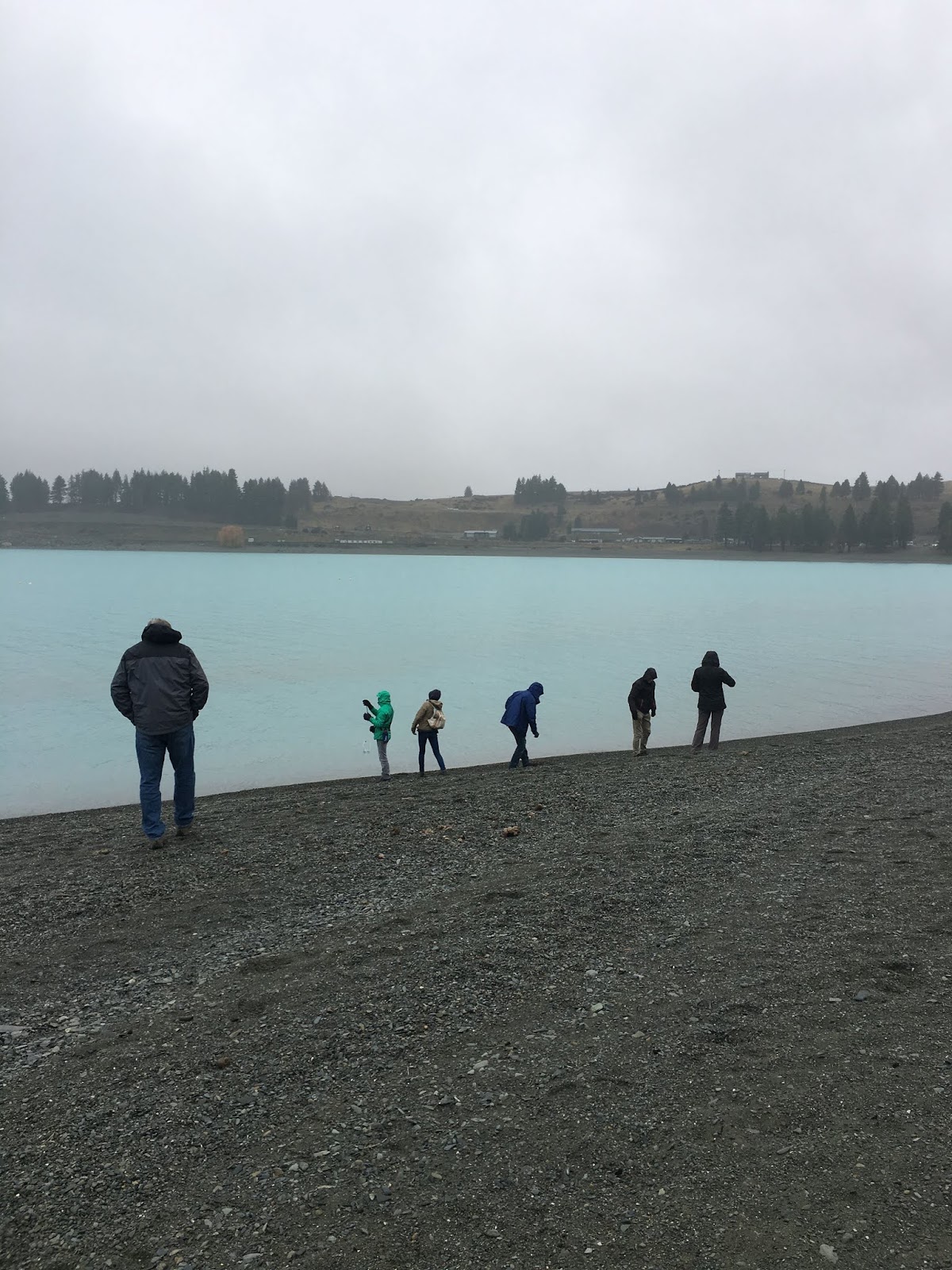
At Lake Tekapo...
-Mark and Meryl
Sweet Dreams Everyone! m&m : )

Thursday, July 18, 2019

July 19-21 Free Weekend Placeholder

 Hi All!  It is that time in the course for a Free Weekend for everyone to have some fun on their own (at least with the buddy system).  Most of our students are off to Queenstown and Miford Sound.  We will report back on Sunday a little about everyone's adventures.  Safe Travels All and Have Fun! m&m : )